Strategy and Fighting the Fewest Battles

Nothing will have a bigger impact on a contractors business over the next decade than putting in a very rigorous process for strategy development and execution.

D. Brown Management Profile Picture
Share

The industry is changing rapidly due to technology, a massive shortage of management talent as well as major trends in project delivery and geographic expansion.  
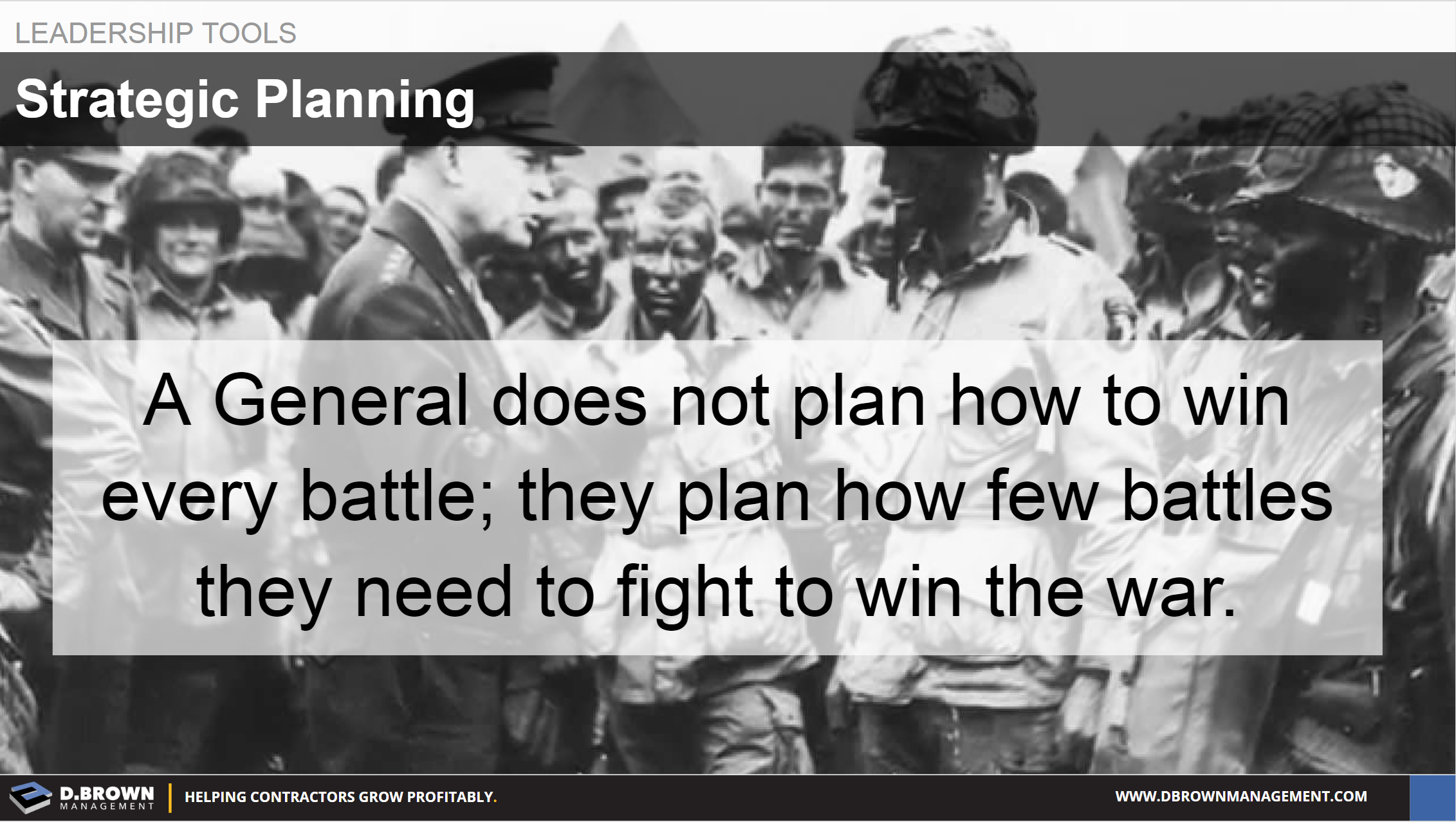
Leadership Tools: Strategic Planning. A General does not plan how to win every battle; they plan how few battles they need to fight to win the war.

Strategic decisions along with the operating rhythms and the feedback mechanisms that ensure execution are the most highly leveraged decisions in the business. 

This is an area where an experienced 3rd party can add significant value.  Find someone that resonates with your team and has experience relevant to your company.  Change the facilitator every few years for fresh ideas. Unless they are really bad don’t change them every year so you have some continuity.  You might consider overlapping facilitators having the outgoing facilitator sit in on your side of the table providing additional continuity.  

Consider bringing in some of your key customers, vendors and subcontractors as part of your strategic planning process.  Whatever you do; don’t underestimate the value of this process.   

Learn More


Change Orders and Average Cost Impact to the Project (Industry Survey)
Changes are a part of the construction process with many underlying causes. While we have all heard the average of 10% changes on construction projects, it is interesting to look at an industry study for validation.
Retirement Onboarding - Introduction
Retirement Onboarding is something that construction business owners must regularly be working on for themselves and other key team members.
Incentive Compensation for Contractors - Alignment
One of the most challenging aspects of incentive programs is communicating demonstrated success in such a way that every functional group believes they have direct impact on their incentive outcome and that it is fairly applied across all stakeholders.