Profitability Trends

When you are looking at your scoreboard, remember that industry average benchmarks and single points in time only tell part of the story.
D. Brown Management Profile Picture
Share

When you are looking at your scoreboard, remember that industry average benchmarks and single points in time only tell part of the story.

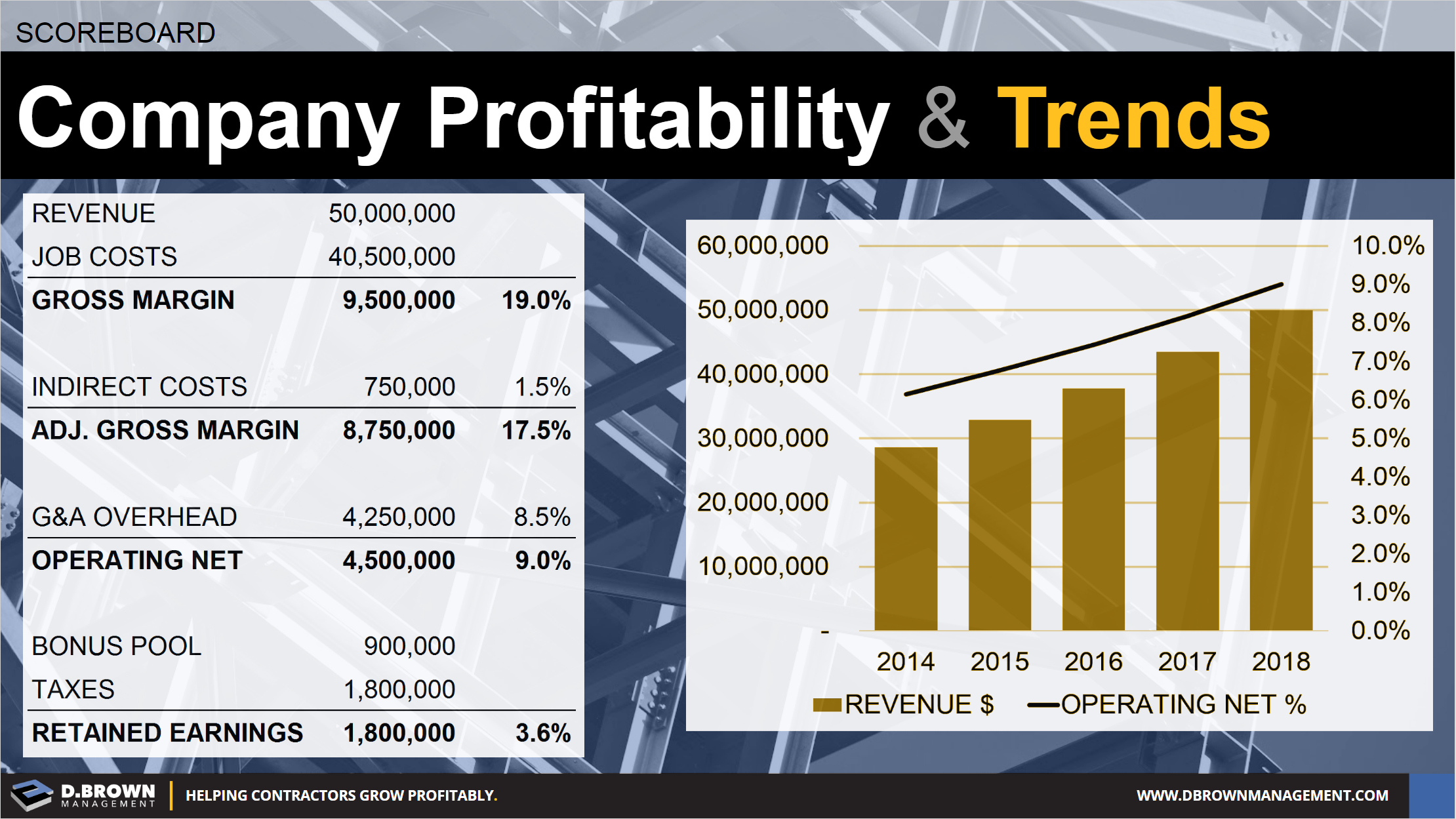
Scoreboard: Invoice and Graph representing Company Profitability and Trends.

Just like physical training, what really matters for your personal health is that you are consistently improving.

  • Graph your key metrics over the last five years and look for relationships.
      
  • Analyze your data and look for outliers to help the trends make more sense. For example, did you have one super good or bad job in a year that completely skewed the metrics?

  • Be cautious not to over-rationalize “outliers.” If you have a bad job every year, remember that is more likely to be part of the trend rather than due to an outlier. For example, Motorola had something like 24 consecutive quarters of “one-time” expenses. If they occur that consistently, they are regular expenses and not one-time expenses. Also, Motorola is no longer around. 
     
  • What do those metric trends look like if you project them another 2-3 years into the future?

  • Which metrics are trending in the right direction?  

  • Which metrics can you improve?  How?  


Want to talk about it? Contact us for a conversation.


Incentive Compensation for Contractors - Culture
Any incentive program should improve the operating execution, profit, and cash flow of the company. Aligning organizational objectives with the tangible value add to the craft worker in the field and operations staff workers yields the best results.
Project Delivery - Design-Bid-Build
The Design-Bid-Build (DBB) method of project delivery is easily the most familiar to owners, architects, and contractors. No contractor should ever lose their ability to compete, win, and build profitable projects using this method of delivery.
The Business of Building Series
Building projects requires technical expertise and resources. Building a construction business is about developing and aligning those capabilities with customers. Growth and time require different leadership focus, strategies, systems, and structure.