Production Tracking - Doing the Math as a Habit

Today contractors have amazing tools for tracking field production such as Rhumbix.

D. Brown Management Profile Picture
Share

We spend a lot of time developing very tightly integrated systems with our clients focused on production feedback.  
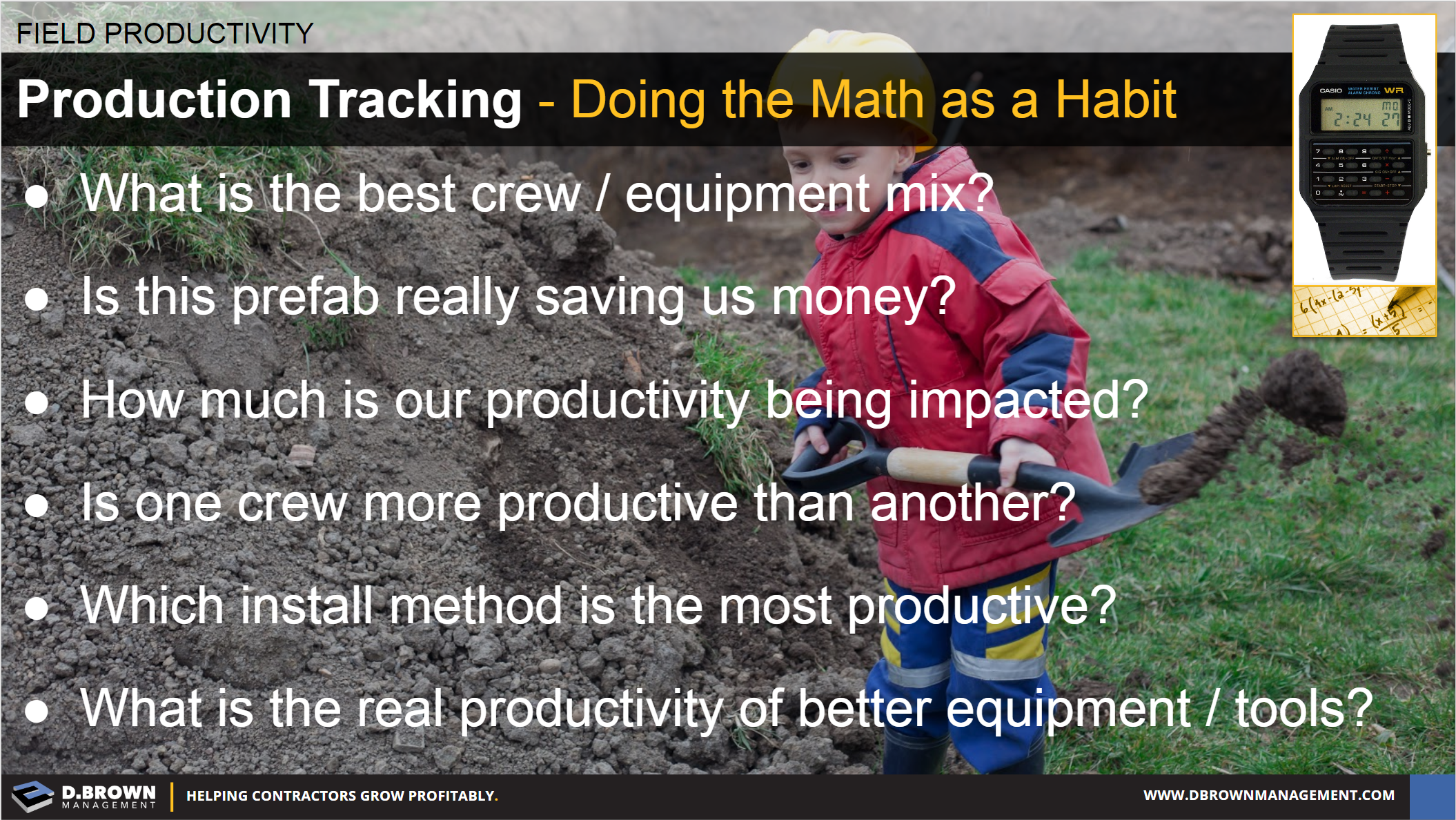
Field Productivity: Doing the math as a habit for Production Tracking.

With all this cool technology we must remember that the foundation of great productivity rests in the people.  Great field leaders have been tracking productivity and making enhancements with pencil, paper, calculators and watches for many years.  The integration of the watch and the calculator was one of the bigger technology enhancements from a few decades ago!  

It is the discipline of making production a daily habit that drives results.  

It is the learned ability to see production details that informs decisions. 

It is the capability to troubleshoot problems that forms the foundation for improvement.  

It is ultimately the ability to make improvements and set new standards that really matters.  

This all starts with the habit of doing the math with the right degree of detail to make great decisions.  Comparing what-if scenarios before starting. Comparing installation methods. Comparing crews. Comparing tools.  Comparing everything!


Improving Labor Productivity Workshop


Production Tracking - Doing the Math as a Habit
Field labor is the often the biggest variable on a construction project - making it the biggest risk and opportunity....

Production Tracking - Doing the Math as a Habit
Field labor is the often the biggest variable on a construction project - making it the biggest risk and opportunity....

Levels of Improvement: Start with the Foundation
Every process in your business including field productivity will go through three levels of improvement: From predictable to productive to scalable. Trying to skip levels is the surest way to slow down improvements across the company.
Aim for the Clouds - Looking at Your Objectives
As contractors plan their businesses, projects, production or improvement goals it’s important to look at objectives in two ways:
Prioritized Development and Improvements
Identifying all the opportunities for development of talent and improvement of the operation for a contractor is overwhelming at best. You can't "punch list" a business like you can a project. Prioritization and sequencing are crucial for success.