Production Tracking - 5 Key Decisions

Implementing or refining a production tracking system in construction requires 5 key decisions.

D. Brown Management Profile Picture
Share

These decisions will vary by project and task.  They will also vary as each project team and the contractor as a whole evolves their approach towards productivity improvements.  
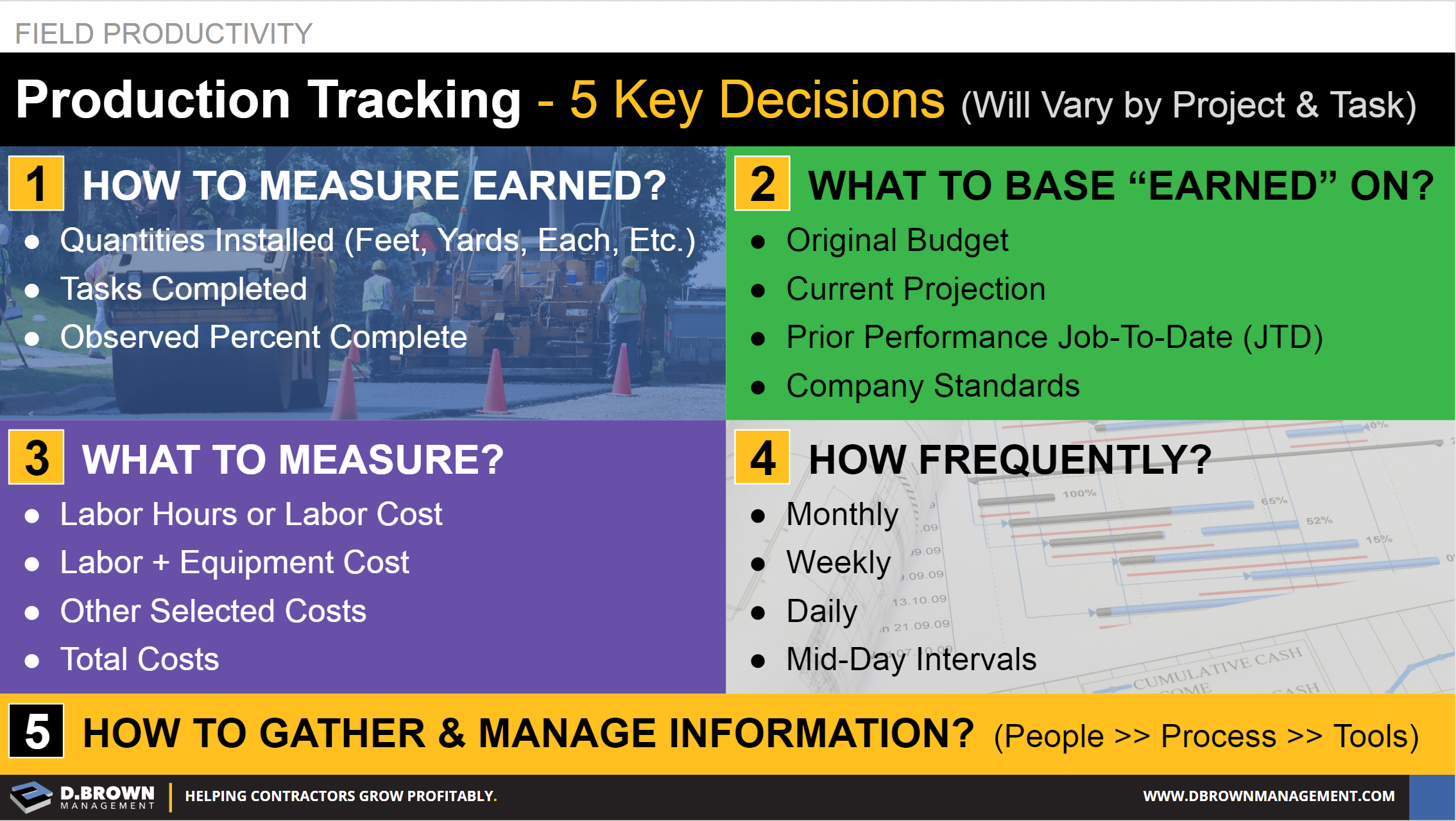
Field Productivity: Production Tracking, 5 Key Decisions. How to measure earned, What to base earned on, what to measure, and how frequently.

Production Tracking Basics

  1. How will we measure what is “Earned” balancing efficiency, accuracy and timeliness?  
  2. What will we based “Earned” on?  This question is really about what sets the standards of performance that are expected in our goal setting.
  3. What costs will we measure?  Focus on the most highly variable costs that the field crews have control over.
  4. How frequently should we measure?  This really gets into a cost-benefit analysis of whether the improvements made by more rapid PDCA cycles outweighs the cost of the more frequent measurements including the estimation of actual costs before the hit the accounting software.   
  5. How will we gather and manage the information?  Focus on people first; then process and tools.  Remember that if the team isn’t troubleshooting effectively and improving each week then production tracking is just data for the sake of data.

Improving Labor Productivity Workshop


Production Tracking - 5 Key Decisions
Field labor is the often the biggest variable on a construction project - making it the biggest risk and opportunity....

Production Tracking - 5 Key Decisions
Field labor is the often the biggest variable on a construction project - making it the biggest risk and opportunity....

Effective Job Role Descriptions for Organizing, Recruiting, Developing, and Retaining Talent
Clarity in job role descriptions is a foundational building block for successful careers and contracting businesses.
Governance Structures Enabling Ownership Transitions
Governance structures including the board of directors, policies, information flow, operating rhythm, and decision rights must continually evolve through each stage of growth and ownership transition. The first board is typically driven by a transition.
Cash Flow Tip 11 - Managing Change Orders
A well managed change order process will have a hugely positive impact on customer satisfaction, profitability, and cash flow. Poorly managed, this will negatively impact all three and will sometimes impact cash for years.