
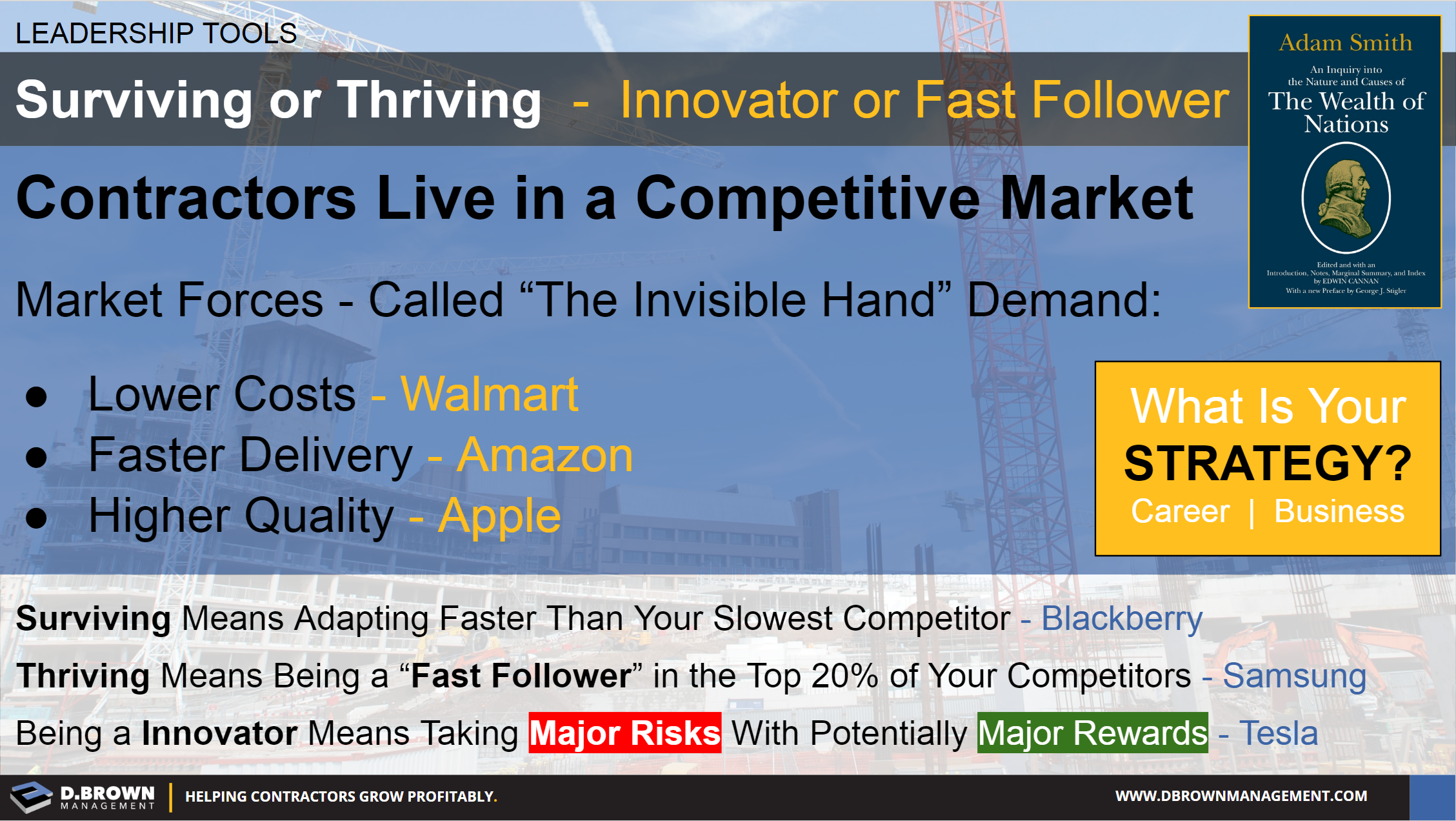
The “Invisible Hand” of the market is constantly demanding that construction projects are delivered:
- Lower Cost
- Faster
- Higher Quality
Whether you are looking at your individual career, a contracting business or the whole value stream of delivering completed projects to a customer you must constantly be focused on being competitive.
Just to survive you must be adapting faster than the slowest of your competition. Survival is not guaranteed and just surviving is not fun.
To thrive you must be in the top 20% of your competition with a team that can rapidly adapt and scale innovations. There are multiple ways to innovate:
- Can’t become operationally more effective than your competition? What if you changed your market strategy and focused on an area where you were in the top 20% or even #1?
- Your current customers don’t compensate you for the additional quality you bring to the table? What if you changed your market strategy finding customers who will pay a premium for that extra quality?
- Have you pulled every lever you can to close the talent and process gaps keeping you from delivering faster with lower costs and higher quality?
When you are in a business with single-digit net profits every bit of discipline in operations matters.
Learn how we help contractors define the right strategies and improve their operations
