Jack Welch - Any Jerk Short-Term Earnings

The ultimate measure of a leader is how well their business unit performs AFTER they are gone.

D. Brown Management Profile Picture
Share

Retired Navy submarine Captain David Marquet explains this very well in:
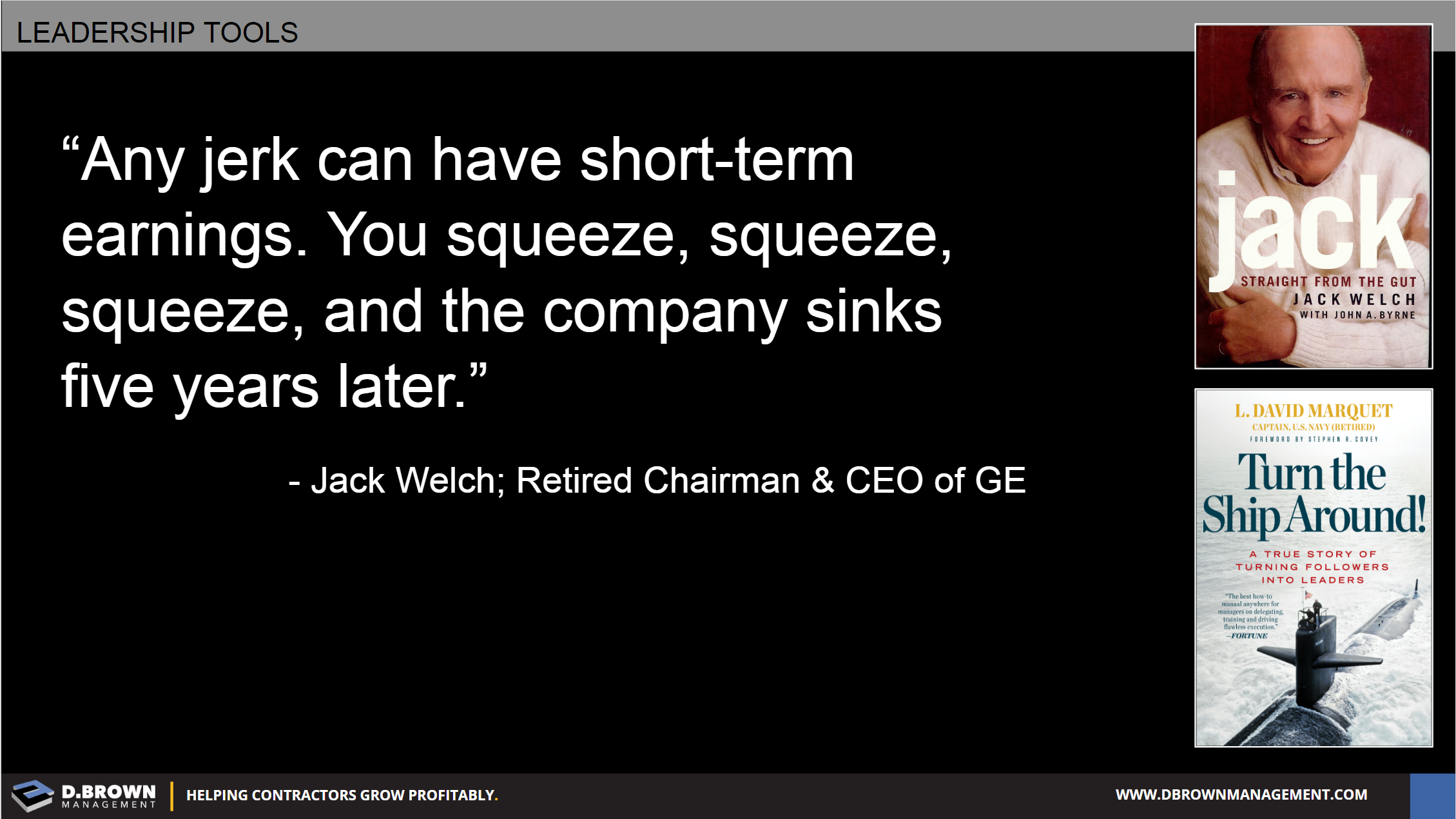
Quote: Any jerk can have short-term earnings. You can squeeze, squeeze, squeeze, and the company sinks five years later. Jack Welch Retired Chairman and CEO of GE.

With the construction industry heading into even bigger talent shortages it is critical that leaders focus on building other leaders.  This must be done at an accelerated rate just for contractors to maintain their market position and profitability.  

Jack Welch discusses this in his memoirs written after he left GE.  

Look at your organizational chart and ask the following: 

  • Who are your strong leaders?  
  • Who are your up-and-coming promising leaders?
  • Who can you trace their development back to?  
  • What training or coaching can you put in place to help your leaders become better people builders?

Evaluate all leaders in your company on the following.  Rate them 0-10 both in today’s demonstrated capabilities AND in what you believe they could be reasonably capable of in 3-5 years.  

  • Building the Projects
  • Building the Business
  • Building the People

Where are your strengths?  Where are your gaps?  

What can you do to leverage those strengths and close those gaps? 


Org Structure Planning (50%)
Planning for a 50% organizational structure is valuable both for contingency planning and for highlighting growth opportunities. Constraints breed creativity, and there is no greater constraint than talent.
Construction Technology Integration Failures
More construction technology integrations FAIL to meet expectations due to alignment with the talent than the capabilities of the technology. If we looked at talent and technology the same way we look at equipment we would achieve a much better return.
Evolution of Project Delivery Methods
Project delivery methods for contractors will become increasingly more integrated from project owner through all key parts of the supply chain, which is a return to models used in the early 1900s with some modernization improvements.