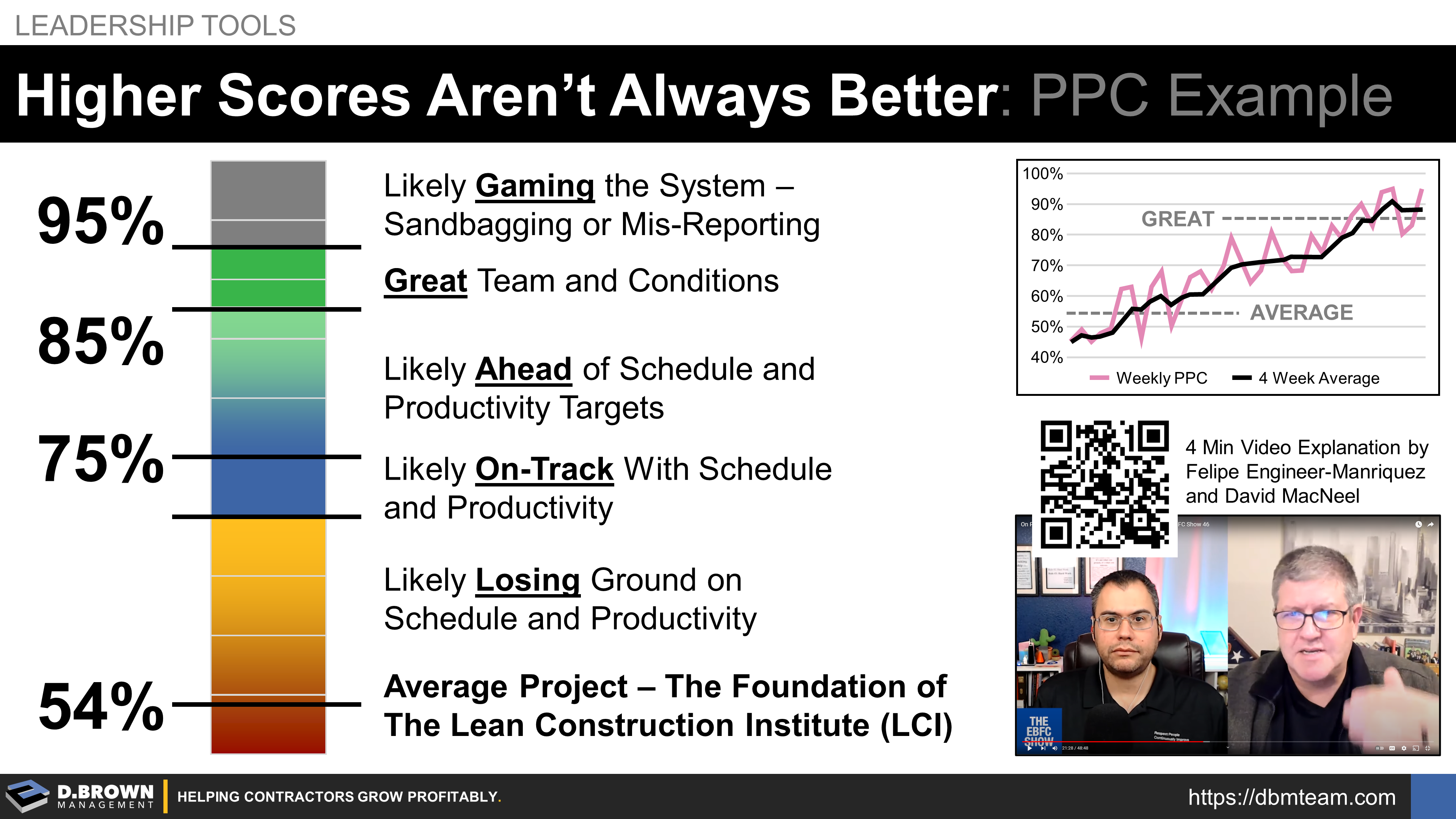
Higher Scores Aren’t Always Better: Percent Planned Complete (PPC) Example

Construction is full of competitive personalities - where more is always better. But that isn't always true. When setting targets, be careful that your goals don't have unintended consequences. Percent Planned Complete (PPC) shows why.

Joseph Irby Profile Picture
Share


Article Image


Percent Planned Complete (PPC) is a critical measure of a weekly work plan or SIP (Short-Interval Plan). 

David MacNeel from On Point Lean describes that higher scores aren't always better in this interview with Felipe Engineer-Manriquez on the EBFC (Easier, Better, for Construction) Show (4 minutes starting at 0:20:00)


54% was the average amount of weekly tasks that got completed as planned when Greg Howell and Glenn Ballard first studied the problem in the late 90s. 

Low to Mid 70s: Likely on-track with schedule and productivity (Two Key Results for Project Planning)

High 70s to High 80s: Likely ahead of schedule and productivity targets. 

High 80s to Low 90s: Great team and conditions.

Mid to High 90s: Likely gaming the system - sandbagging or misreporting. 


An important part of your scorekeeping process is setting appropriate targets with tolerances and clear management escalations if there are large variances, or they are trending in the wrong direction for too long. 


Related Training

Resource - 2 Second Lean
Dozens of practical and fun ways to save a few more seconds each day. 3 minutes per day of additional productive time on tools (ToT) equals about a 1% labor savings - or $10K for every $1M in job cost labor. Helps develop a continuous improvement culture.
Percent Planned Complete (PPC) - Calculation Example
Yoda would be the perfect coach for managing schedules on projects: “Do or do not. There is no try.” This is the heart of Percent Planned Complete (PPC) and the weekly cycle of continuous production improvement.
Evolution of Project Delivery Methods
Project delivery methods for contractors will become increasingly more integrated from project owner through all key parts of the supply chain, which is a return to models used in the early 1900s with some modernization improvements.