General Mattis and Making Speed Part of Your Culture

The concepts of speed, harmony, commander’s intent, and leadership form the bedrock of General Mattis’s philosophy.

D. Brown Management Profile Picture
Share

"Operations occur at the speed of trust." - Retired General Jim Mattis

"Time wounds all deals, sometimes even fatally." - Stephen A. Schwarzman
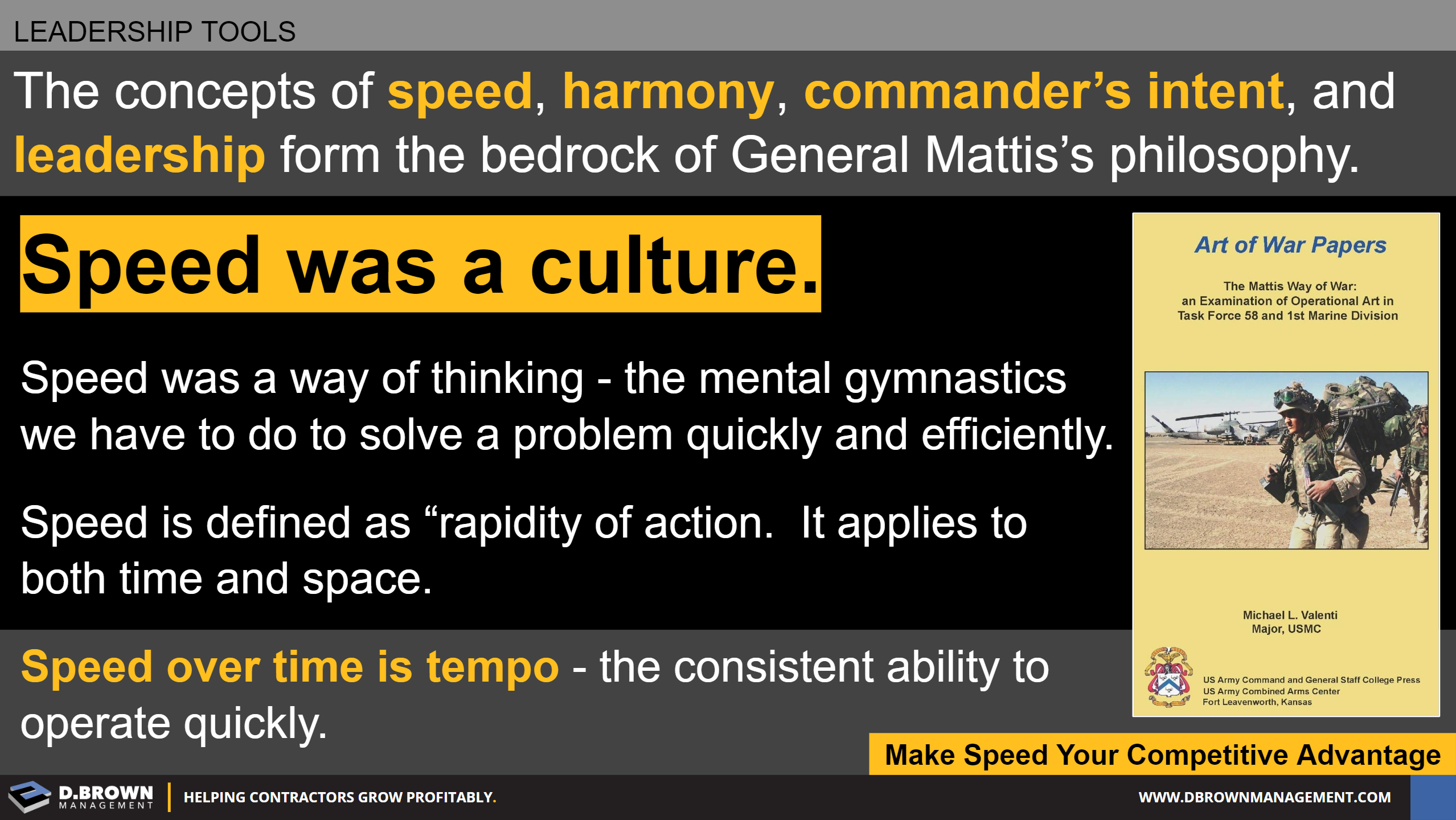
Leadership Tools: The concepts of speed, harmony, commander's intent, and leadership form the bedrock of General Mattis's philosophy. Make speed your competitive advantage.

Michael L. Valenti (Major, US Marines) studied the leadership principles, strategies, structure, and tactics used by General Jim Mattis. He used the word "speed" over 50 times to describe General Mattis.  

The Mattis Way of War: An Examination of Operational Art in Task Force 58 and 1st Marine Division 

The concepts of speed, harmony, commander’s intent, and leadership form the bedrock of General Mattis’s philosophy. Make speed your competitive advantage in your career, on your project, and as a contractor.

Speed was a culture.

  • Speed was a way of thinking - the mental gymnastics we have to do to solve a problem quickly and efficiently.
  • Speed is defined as “rapidity of action. It applies to both time and space.
  • Speed over time is tempo - the consistent ability to operate quickly.


Make speed your competitive advantage.  


Related Training

A Business Exists to Serve a Customer
Without satisfied and growing customers, nothing else a contractor does will matter. Few things are more profitable for contractors than recurring work negotiated with a select group of project owners.
8 Stages of Personal and Team Growth
Exploration expands our context. Learning and deliberate practice builds and demonstrates our individual productivity. Develop team productivity with four levels of leveraging yourself through others. Take an inventory of where you and your team are at.
Contractor Profiles in Recession Management
3X your profitability during a recession. Look at how you performed during the last recession then evaluate your current readiness and plan your next steps.