6 Common Exit Strategies for Contractors

Contracting is a capital-intensive and risky business with potentially volatile profit margins.

D. Brown Management Profile Picture
Share

The construction business is also amazing, with the owners making a good return on their capital. Management teams and employees earn a great living while building projects they can be proud of that will last for generations.
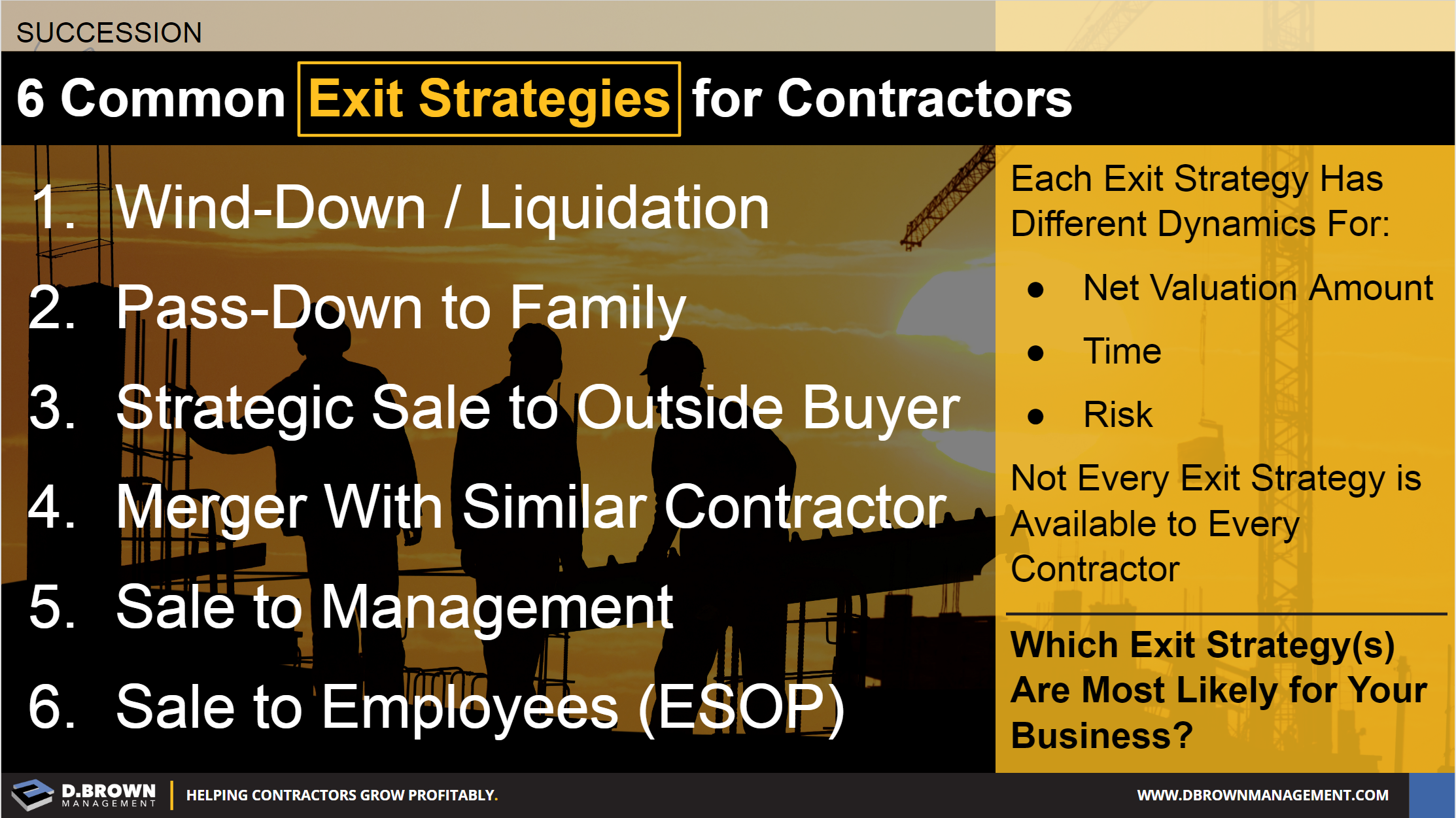
Succession: Six Common Exit Strategies for Contractors. Liquidation, Pass Down to Family, Strategic Sale to Outside Buyer, Merger with Similar Contractor, Sale to Management, Sale to Employees.

The majority of contractors are privately owned by a small group of people who are usually also managing the business. 

Over time, those owners need to: 

  • Reduce how much time they spend in the business
  • Get their capital out of the business
  • Reduce their risks

There are 6 common exit strategies for these owners:

  1. Wind Down / Liquidation
  1. Pass Down to Family
  1. Strategic Sale to Outside Buyer
  1. Merger With Similar Contractor
  1. Sale to Management
  1. Sale to Employees (ESOP)

Each of these strategies has different dynamics for the net valuation amount, time, and risk. Not every strategy is available to or right for every contractor.  

We will explore each of these in more detail with future posts to help you identify which might be best for your situation.  


6 Common Exit Strategies for Contractors
Continue building value in your business, yourself and your key team members with a good succession strategy....

6 Common Exit Strategies for Contractors
Continue building value in your business, yourself and your key team members with a good succession strategy....

Issue 2 of 9: Culture
Construction Ownership Transition Issue 2 of 9: Is the Culture Truly Ready for Succession? Why does it matter to the employees what happens with succession? How does that impact value?
Four Levels of Integration and Optimization
Operational excellence must be a major component of every contractor’s strategy and baked into their daily behaviors. Optimizing at each of the four major layers requires different levels of thinking, technology, and time span.
Production Tracking - Total Daily Production
Look at productivity as a daily “Jar” where your objective is to pack as much “Earned Value” into it as possible. Look at your costs in three major categories and focus on tracking what matters the most.